What is Olum.ai?
Olum.ai tracks and improves how your business gets found in both Google and AI answer engines like ChatGPT, Perplexity, and Claude — in one platform.
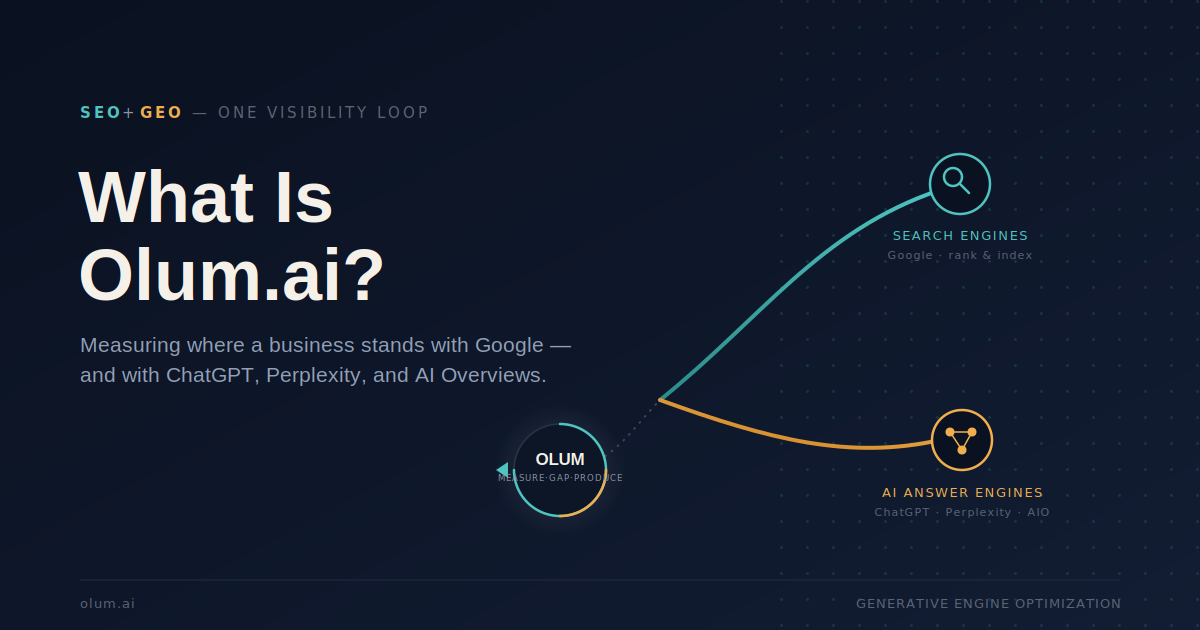
Olum.ai is a platform that tracks and improves how a business gets found in two places at once: traditional search engines like Google, and AI answer engines like ChatGPT, Claude, Perplexity, and Google's AI Overviews. It crawls your site, connects to your existing Google Search Console and Analytics accounts, runs the technical checks a normal SEO tool would run, and then does the part most tools skip entirely — it asks AI systems the kinds of questions your customers actually ask, and checks whether your business gets mentioned in the answer.
Search stopped being one thing this year.
For two decades, “search” meant typing a phrase into a box and scanning a page of blue links. That’s still happening, sure. But sit next to almost anyone under forty and watch how they actually find things now, and you’ll notice they’ve quietly split their behavior in two. Half the time they Google it. The other half, they just ask ChatGPT, Perplexity, or whatever AI assistant is already open in another tab, and they take the answer it gives them without ever clicking through to a website.
That second habit doesn’t show up in a marketing dashboard anywhere. And that gap, the space between what’s actually happening to your traffic and what your tools can show you, is exactly why Olum.ai exists.
The short answer
Olum is a platform that tracks and improves how a business gets found in both of those worlds at the same time: traditional search engines like Google, and AI answer engines like ChatGPT, Claude, Perplexity, and Google’s AI Overviews. It connects to your site and your existing Google accounts, runs the technical checks a normal SEO tool would run, and then does the part most tools skip entirely — it asks AI systems the kinds of questions your customers actually ask, and checks whether your business gets mentioned in the answer.
Inside the product, this has a name. The team calls it GEO, short for Generative Engine Optimization: the practice of earning a citation from an AI system instead of a ranking on a results page. Pair that with classic SEO, and you get the full picture of “can people find me,” across both places people now look.
Why it isn’t just another SEO dashboard
Most SEO software was designed around a single assumption: that visibility means rank position. Higher on the page is better. That assumption held up fine for twenty years, because there was always a page.
AI answer engines don’t have one. When someone asks ChatGPT to recommend a project management tool, there’s no scrollable list with your name at position seven. There’s a paragraph, maybe with two or three sources cited underneath it, and you’re either in that short list or you’re not. Rank tracking software has nothing to say about that world, because the entire concept it was built to measure doesn’t apply.
Olum was built after that assumption broke, not before it, which is the practical difference. It treats “were we cited” as a first-class metric alongside “did we rank,” rather than bolting AI features onto a tool that was never designed to think that way.
What it looks like in practice
You give it a URL. It crawls the site, pulls in your Google Search Console and Analytics data, and runs a technical audit covering things like Core Web Vitals, schema markup, and crawlability. Nothing unusual so far.
Then it starts probing AI platforms with real buyer questions related to your business and industry, tracking exactly where you show up, where a competitor shows up instead, and where nobody gets mentioned at all. It also listens to what people are actually asking about your category on Reddit and Quora, so the content it eventually suggests is answering questions real people asked, not guesses based on keyword volume.
Everything gets pulled into one ranked list of what to fix and what to write next, instead of leaving you to stitch together conclusions from five separate tools.
Who’s actually using it
Right now, Olum runs four self-serve plans. Founders and marketers managing a single site can start on Olum Lite at $29 a month or Olum at $100 a month, and agencies handling a portfolio of client sites can use Olum Studio at $349 a month. Studio Lite adds a real person to the entry plan at $175 a month. All four are live and self-serve.
The bigger idea underneath it
Here’s the part worth sitting with. If AI answer engines really are becoming a meaningful share of how people discover businesses, then “we don’t know if we’re visible there” is a genuinely dangerous blind spot, not a nice-to-have metric. Olum’s bet is that measuring this well, and then actually doing something about the gaps it finds, is going to matter a lot more in the next few years than it does today.
Whether that bet is right depends on how fast AI search keeps growing. But the underlying question it’s built to answer, does an AI system trust us enough to mention us, is one almost nobody was asking a few years ago. Now it’s arguably one of the more important questions in marketing.
Frequently asked questions
- What does GEO mean in Olum?
- GEO stands for Generative Engine Optimization: the practice of earning a citation from an AI system instead of a ranking on a results page. Olum treats GEO as a first-class metric alongside classic SEO, because AI answer engines have no ranked list to place on — you are either one of the few sources the model cited, or you are absent from the answer entirely.
- How is Olum different from an SEO tool like Ahrefs or Semrush?
- Traditional SEO software is built on the assumption that visibility means rank position, which holds only as long as there is a results page. AI answer engines do not have one. Olum was built after that assumption broke, so it measures "were we cited" as a primary metric rather than bolting AI features onto a rank tracker.
- Which AI platforms does Olum check?
- Olum probes four AI answer engines: ChatGPT, Perplexity, Claude, and Google's AI Overviews. For each buyer question it tests, it records whether your business was cited, where in the answer the citation appeared, how strong that citation was, and how confident the system is in that reading.
- Do I need to install anything to use Olum?
- No. You give Olum a URL and connect your existing Google Search Console and Google Analytics accounts. Olum crawls the site directly and pulls your click, impression, and traffic data through those connections, so there is no agent, tag, or code change required to get started.
- How much does Olum cost?
- Olum runs four self-serve plans. Olum Lite, the entry plan, is $29 per month for a single site, or $20 per month billed annually, and Studio Lite adds a real person running it for $175 per month, or $122 per month billed annually. Olum is $100 per month for a single site, or $70 per month billed annually. Olum Studio, built for agencies managing a portfolio, is $349 per month or $244 per month billed annually and covers up to ten sites, with a human team executing the work. All four are live and self-serve.
Written by The Olum Team. Olum (olum.ai) is an AI visibility platform for small businesses and agencies.