Does Olum provide an AI visibility audit?
Yes — Olum probes four AI platforms with real buyer questions, tracks citations as a trend rather than a snapshot, and reports a GEO readiness score.
Yes. An AI visibility audit answers one question: when someone asks an AI system like ChatGPT or Perplexity something related to your business, do you get mentioned in the answer? Olum runs real buyer questions through four platforms, records whether you were cited and how strongly, repeats the probes over time so results read as a trend rather than a single snapshot, builds a coverage matrix showing every gap, and rolls everything into a GEO readiness score weighted across five areas.
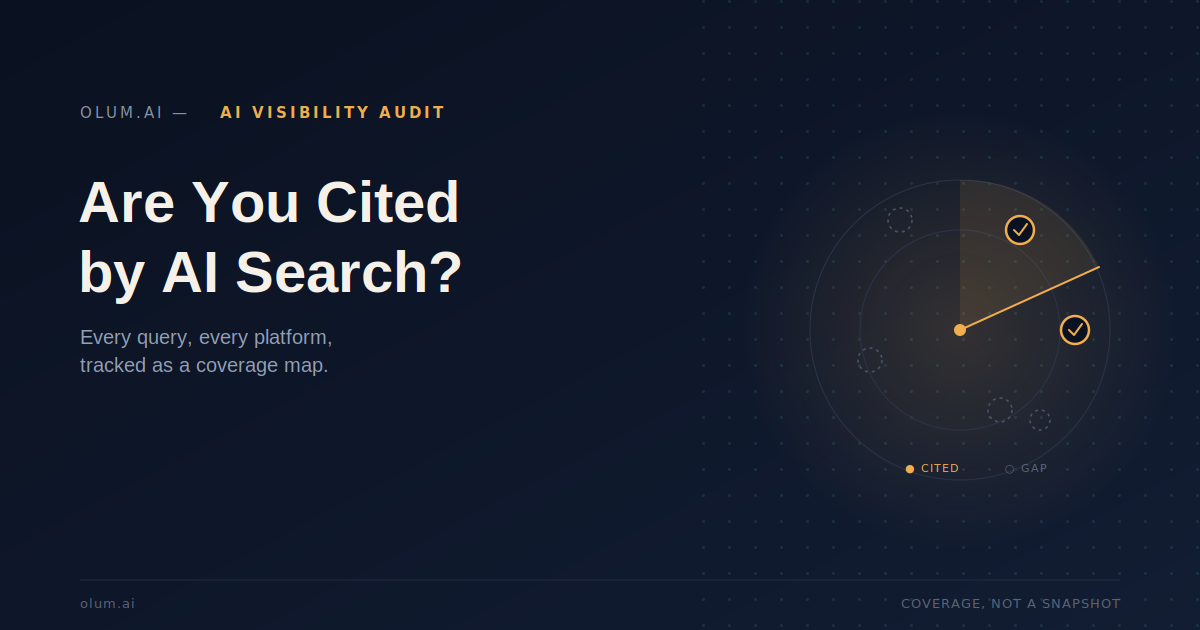
Yes. It’s arguably the core reason the product exists at all, not a bolt-on feature added to an existing SEO tool.
An AI visibility audit answers one specific question: when someone asks an AI system like ChatGPT or Perplexity a question related to your business, do you get mentioned in the answer? That’s a different question from “am I ranking on Google,” and it needs a different kind of audit to answer honestly. Here’s what Olum’s version actually covers.
It probes real AI platforms with real questions
Olum runs actual buyer questions, the kind a potential customer might type into ChatGPT before making a decision, through four AI platforms: Perplexity, ChatGPT, Claude, and Google’s AI Overviews. For every question, it records whether your business was cited, where in the answer the citation appeared, how strong the citation was, and how confident the system is in that read. That last part matters more than it sounds like it should.
It’s honest about a system nobody can fully control
Here’s something most GEO tools gloss over: AI answer engines are not deterministic. Ask the same question twice, on different days, and you can get a different answer with different citations, simply because the model or the retrieval behind it shifted slightly. A single audit run captures almost nothing meaningful on its own.
Olum’s audit is built around that reality instead of pretending it doesn’t exist. It runs probes repeatedly and tracks results as a trend, not a one-time score. Every citation carries a confidence value alongside it. Small movements get treated as noise instead of being dressed up as a dramatic shift. If you’ve ever watched a metric swing wildly for no clear reason and had no way to tell whether it meant anything, this is the fix for that problem.
It shows you the full coverage picture, not just the wins
A lot of visibility tools only tell you about the queries where you won. Olum’s audit builds what it calls a coverage matrix from every single question it tests, across every platform, marking each one as answered, partially answered, not answered at all, or not yet tracked. That means the gaps are visible on purpose, instead of being invisible by omission. A query where an AI system generated an answer and cited nobody but a competitor gets flagged explicitly as a gap, not quietly left off the report.
It tracks citations you’ve lost, not just ones you’ve gained
The audit keeps a running ledger of every citation ever observed, tagging each one as new, retained, or dropped. That distinction turns out to matter a lot. A citation you never had and a citation you used to have and lost are completely different problems requiring completely different fixes, and most tools can’t tell you which one you’re looking at.
It scores your overall readiness
Beyond individual queries, the audit rolls up into a single GEO readiness score, weighted across five areas: how well your llms.txt file is set up (an emerging standard for telling AI crawlers how to read your site), your actual AI platform visibility, your content authority, your technical signals, and your topic coverage. Each weighted piece comes with its own breakdown, so a low score points you straight at what’s dragging it down instead of leaving you to guess.
What it actually gives you at the end
The finished audit hands back a prioritized list of gap actions, each one explaining why you weren’t cited for a specific question, which lever is most likely to fix it (content, schema, entity signals, authority, or freshness), and who’s winning that citation instead of you. It’s built to be actionable on the same afternoon you read it, not a report that sits in a folder.
If you’ve never had visibility into whether AI systems even know your business exists, this is what closing that blind spot actually looks like.
Frequently asked questions
- Why does Olum run AI probes repeatedly instead of once?
- Because AI answer engines are not deterministic. Ask the same question twice on different days and you can get a different answer with different citations, simply because the model or the retrieval behind it shifted. A single audit run captures almost nothing meaningful on its own, so Olum tracks results as a trend and treats small movements as noise rather than signal.
- What is a coverage matrix?
- It is a grid built from every question Olum tests, across every platform, marking each cell as answered, partially answered, not answered, or not yet tracked. Because it is built from all probe outcomes rather than only the wins, the gaps are visible on purpose instead of invisible by omission. A query where an AI cited only a competitor is flagged explicitly.
- Can Olum tell me if I lost a citation I used to have?
- Yes. The audit keeps a running ledger of every citation ever observed, tagging each as new, retained, or dropped. That distinction matters more than it sounds: a citation you never had and a citation you used to have and lost are different problems requiring different fixes, and most tools cannot tell you which one you are looking at.
- What goes into the GEO readiness score?
- Five weighted areas: how well your llms.txt file is set up, your actual AI platform visibility, your content authority, your technical signals, and your topic coverage. Each weighted component comes with its own breakdown, so a low score points straight at what is dragging it down rather than leaving you to guess.
- What do I actually get at the end of the audit?
- A prioritised list of gap actions. Each one explains why you were not cited for a specific question, which lever is most likely to fix it — content, schema, entity signals, authority, or freshness — and which domain is winning that citation instead of you. It is built to be actionable the same afternoon you read it.
Written by The Olum Team. Olum (olum.ai) is an AI visibility platform for small businesses and agencies.