How is Olum different from traditional SEO software?
Olum measures AI citations as well as rankings, labels how trustworthy each figure is, sources questions from real discussions, and generates the fix.
Five concrete differences. Olum measures AI citations alongside rankings, because AI answers have no results page to rank on. It labels every figure by how trustworthy it is rather than presenting all numbers as exact. It sources questions from live Reddit and Quora discussions instead of keyword-volume estimates. It generates the actual fix rather than stopping at the report. And it replaces a five-tool stack with one pipeline that ends in a single ranked action list.
If you’ve used a traditional SEO suite, you already know the routine. You log in, check where your keywords rank this week, glance at a technical health score that never seems to move much, maybe export a backlink report nobody on the team actually reads. It’s useful. It’s also built around a version of search that’s slowly stopped being the whole story.
Olum starts from a different premise, and that shows up in a handful of concrete ways.
It measures a second kind of search entirely
Traditional SEO software answers one question: where do you rank on a results page. That’s a complete answer as long as results pages are where people actually look. Increasingly, they’re not. When someone asks an AI assistant a question instead of Googling it, there’s no results page to rank on at all, just a generated answer with a few sources cited underneath.
Olum tracks both. It does the classic SEO job, keyword tracking, technical audits, index coverage, but it also probes AI platforms directly to see whether your business gets cited in an actual AI-generated answer. Most SEO tools simply have nothing to say about that second world, because they were built before it mattered.
It’s honest about uncertainty instead of hiding it
Traditional rank trackers give you a clean number and let you assume it’s exact, because for the most part, it is; a rank position is a rank position. AI citations don’t work that way. Ask a system the same question twice and you can get different sources cited, simply because the model or its retrieval shifted slightly between runs.
A lot of tools entering this space paper over that problem and hand you a tidy “visibility score” anyway. Olum tags every AI-derived figure by how trustworthy it actually is: confirmed and exact, calculated from solid inputs, or directional, meaning the trend is meaningful but the specific number shouldn’t be taken literally. Tiny movements get shown as flat instead of dressed up as a swing. It’s a small design choice with a big effect: you stop panicking over noise.
It listens to real questions instead of estimating them
Keyword research tools infer what people want to know from search volume models, which is a reasonable proxy but still a guess. Olum pulls actual questions from live Reddit and Quora discussions, with real engagement numbers attached, and matches them to specific pages on your site. Content built from a question a real person actually typed starts from evidence. Content built from a volume estimate starts from an inference. That’s a meaningfully different foundation to write from.
It closes the loop instead of stopping at the report
This might be the biggest practical difference. A traditional SEO tool tells you a page is missing schema markup or that a keyword opportunity exists, and then the work of actually fixing it lands entirely on you. Olum generates the fix itself, whether that’s a ready-to-paste code snippet or a full blog draft addressing a specific gap it found. The tool doesn’t just diagnose the problem; it hands you something to publish.
It replaces a stack, not just a feature
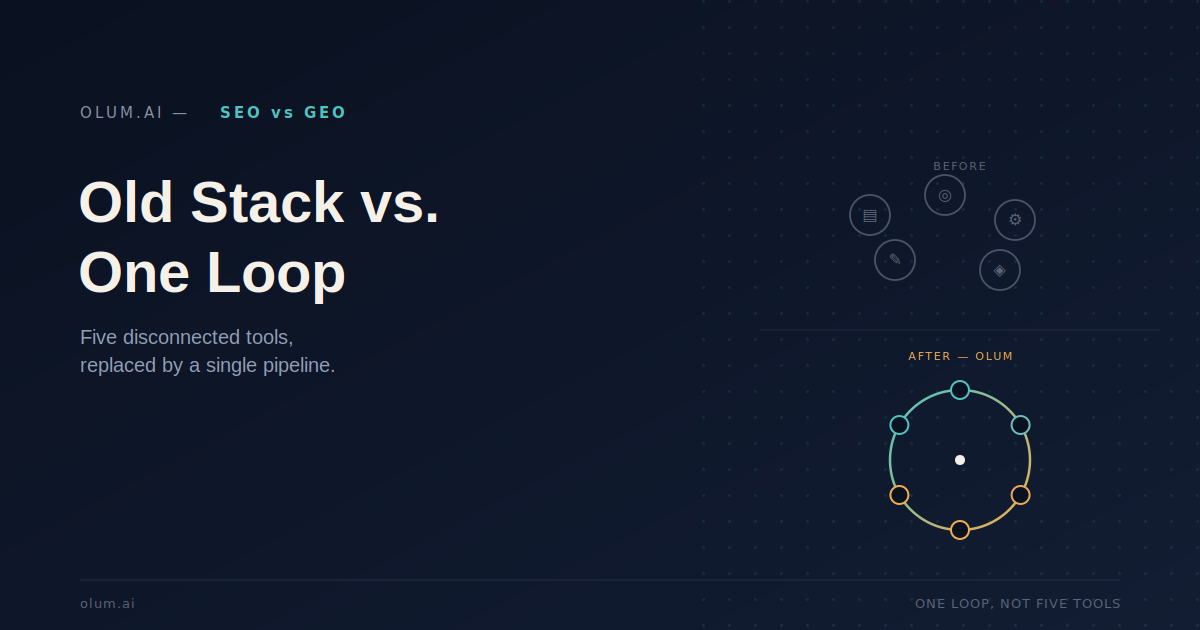
Most teams running SEO seriously end up with five separate tools: a rank tracker, a technical crawler, an analytics dashboard, a social listening tool, and something to generate content briefs. None of them share data, so connecting the dots is manual work every single week. Olum runs all of that through one pipeline and assembles it into a single ranked list of what to do next, which sounds like a small convenience until you’ve actually lived through the alternative.
The honest caveat
Olum can’t yet tell you whether any of this translated into revenue. It tracks traffic, technical health, and AI citation growth, but conversion and revenue data aren’t wired in yet. If proving direct ROI is your top requirement today, that’s a real gap worth knowing about going in. It’s a fixable one, not a fundamental limitation of how the product is built, but it’s fair to flag before you commit to it.
Frequently asked questions
- Does Olum replace my rank tracker?
- Olum does the classic SEO job — keyword tracking, technical audits, index coverage — alongside AI citation tracking. For most teams it consolidates a rank tracker, a technical crawler, an analytics dashboard, a social listening tool, and a content brief generator into one pipeline, which is the main practical reason to switch rather than add another subscription.
- Why does Olum label some numbers as directional instead of exact?
- Because they are not equally reliable. Figures from Google Search Console and Analytics are reproducible, so Olum marks them exact. AI citation figures come from systems that return different answers between runs, so they are marked directional: the trend is meaningful, the specific number should not be read literally. Tiny movements display as flat rather than as a swing.
- How is Olum's keyword research different?
- Traditional keyword tools infer what people want to know from search volume models, which is a reasonable proxy but still a guess. Olum pulls actual questions from live Reddit and Quora discussions with real engagement numbers attached, then matches them to specific pages on your site. Content built from a question someone actually typed starts from evidence rather than inference.
- What does "closing the loop" mean in practice?
- A traditional tool tells you a page is missing schema markup or that a keyword opportunity exists, and the work of fixing it lands entirely on you. Olum generates the fix itself — a ready-to-paste code snippet, or a full blog draft addressing the specific gap it found — so you finish with something publishable rather than another finding.
- Can Olum prove SEO return on investment?
- Not yet. Olum tracks traffic, technical health, and AI citation growth, but conversion and revenue data are not wired in. If proving direct ROI is your top requirement today, that is a real gap worth knowing about before you commit. It is a fixable one rather than a fundamental limitation of how the product is built.
Written by The Olum Team. Olum (olum.ai) is an AI visibility platform for small businesses and agencies.