What does Olum.ai do?
Olum crawls your site, audits it against Google, probes AI engines for citations, listens to real buyer questions, and drafts the content that closes the gap.
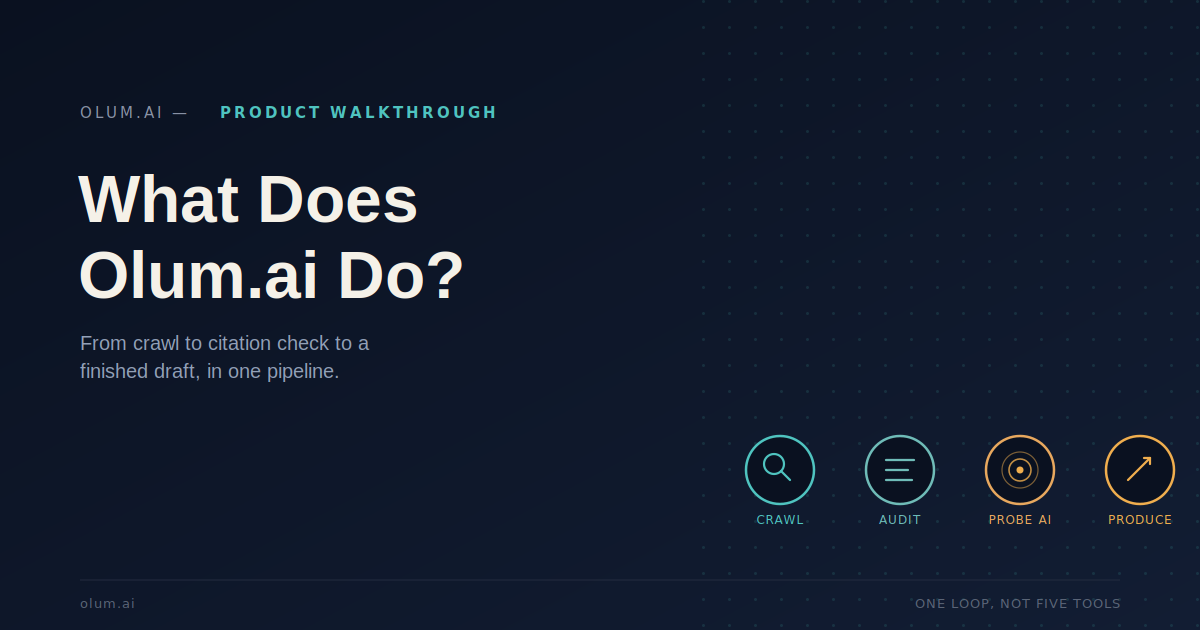
Olum does five things in one pipeline. It crawls your site and pulls in your existing Google Search Console and Analytics data. It audits how you look to Google, flagging quick wins, striking-distance terms, and queries losing ground. It probes four AI platforms to see whether they cite you. It listens to real questions on Reddit and Quora. Then it generates the content that closes whatever gap it found — and hands you one ranked action list instead of five dashboards.
Picture a Monday morning for most marketing teams. One tab open for the rank tracker. Another for the analytics dashboard. A third for the technical crawler that flags broken schema. A fourth for whatever tool spits out content briefs. None of them talk to each other, and putting together an actual plan for the week means manually stitching four different stories into one.
Olum.ai was built to replace that morning entirely. Here’s what it actually does, from the moment you sign up to the moment you publish something.
It crawls your site and connects your existing data
The first thing Olum does is pull in what you already have. It connects to Google Search Console and Google Analytics, so your click, impression, and traffic data flows straight in without re-entering anything. Then it crawls your site directly, running a full technical audit: crawlability, Core Web Vitals, schema coverage, on-page structure. Before it commits to a full crawl, it actually runs a live browser check first, called a preflight, to catch anything that would silently block the crawl, like a stray noindex tag or a robots.txt rule nobody remembers setting.
It audits how you look to Google
Once the crawl is done, Olum breaks down your Search Console data in a way that’s actually usable instead of just a wall of numbers. It flags quick wins, keywords that are already ranking and sitting close enough to page one to be worth pushing. It flags striking distance terms, where you’re getting real impressions but a weak position. And it flags erosion, queries that are quietly losing ground before anyone notices the drop in a monthly report.
Every technical issue it finds comes with more than a diagnosis. It generates the actual fix, whether that’s a ready-to-paste schema block, a specific config change, or a step-by-step remediation, so the audit turns into a to-do list instead of a PDF nobody reads.
It checks whether AI systems actually mention you
This is the part most SEO tools don’t do at all. Olum takes real questions your customers might ask and runs them through AI platforms, ChatGPT, Perplexity, Claude, and Google’s AI Overviews, then records whether you were cited, how strongly, and where a competitor showed up instead. It repeats this over time rather than relying on a single snapshot, because the same question can return a different answer on a different day. The result is a map of exactly which questions you’re winning, which you’re losing, and which nobody’s answering for you yet.
It listens to what people are actually asking
Separately, Olum tracks public conversations on Reddit and Quora related to your industry, matching real questions people are asking to specific pages or services on your site. It even scores how safe it is to engage in a given community, so you’re not walking into a subreddit and getting banned for showing up with a sales pitch. This is where the content ideas come from: not a keyword volume estimate, but an actual question a real person typed out.
It writes the thing that closes the gap
Once it’s found a gap, whether that’s a missing schema type, a question nobody’s answering, or a keyword sitting just out of reach, Olum generates the content to fix it. Blog drafts, social posts tailored to each platform, even a version of your own voice that gets more accurate the more you edit its drafts. Nothing gets posted automatically; you review it and publish it yourself, but the first draft is already sitting there waiting.
It hands you one list, not five dashboards
All of this feeds into a single ranked action list, refreshed weekly, that tells you what changed, what needs attention first, and what’s ready to ship. That’s really the whole point of the product: not another dashboard to check, but one weekly answer to the question “what should I actually work on.”
Frequently asked questions
- What is a preflight check?
- Before Olum commits to a full crawl, it runs a live browser test confirming the page is genuinely fetchable and renderable. That catches problems a standard crawl would miss entirely: a stray noindex tag, an X-Robots-Tag header quietly blocking indexing, a robots.txt rule nobody remembers setting, or a page that renders blank to a bot even though it looks fine to a human.
- What are quick wins, striking distance, and erosion?
- They are three signals Olum reads out of your Search Console data. Quick wins are keywords already ranking close enough to page one to be worth pushing. Striking distance means you are collecting real impressions at a weak position. Erosion flags queries quietly losing ground, so a decline surfaces before it shows up in a monthly report.
- Does Olum fix the issues it finds, or just report them?
- Every technical issue comes with the actual fix attached, not only a diagnosis. That might be a ready-to-paste JSON-LD schema block, a specific configuration change, or an ordered set of remediation steps. The intent is that the audit reads as a to-do list you can work through rather than a PDF nobody opens.
- Does Olum post content automatically?
- No. Olum generates blog drafts and platform-specific social posts, and it learns your voice from the edits you make to its drafts, but nothing publishes on its own. You review each piece and publish it yourself. Olum hands over the finished markdown and the platform's editor link rather than posting on your behalf.
- How does Olum know what content to suggest?
- It tracks public conversations on Reddit and Quora related to your industry, matching real questions people asked to specific pages or services on your site. It also scores how safe it is to engage in a given community, so you are not walking into a subreddit and getting banned for arriving with a sales pitch.
Written by The Olum Team. Olum (olum.ai) is an AI visibility platform for small businesses and agencies.